








Articles
Legal updates, insights and expert opinion on what matters to you.
Have you been injured in an accident that wasn't your fault? You could make a claim - our expert team are here to help you.
Fill in the form below to get in touch with one of our dedicated team members, or call our team today on: 0800 260 5010
From understanding your rights to what happens during a claim, our Personal Injury content hub brings together expert insight, practical guides and real client outcomes.

If you have been injured in an accident at work that was not your fault, you may be able to claim compensation. Our specialist Personal Injury Solicitors can advise you on your options.
Workplace accidents can have serious consequences, affecting your health, your ability to work, and your financial stability. To support you during this time, we offer a free initial claims assessment, without the obligation to proceed, and handle most cases on a No Win, No Fee basis, so there are no upfront legal costs.
To find out if you have a claim, call us on 0800 260 5010 or request a callback at a time that suits you.
When you choose Simpson Millar to handle your claim, you will be supported by a team of highly experienced legal specialists focused on achieving the best outcome for you. We're proud to be recognised in Chambers and Partners and the Legal 500, reflecting our commitment to excellence. We're also accredited by the Solicitors Regulation Authority (SRA) and the Law Society's Lexcel standard, ensuring the highest level of service and professionalism.
We understand the difficulties people face after a workplace injury, which is why we aim to make the legal process as seamless and stress-free as possible. Our team works closely with medical professionals, where appropriate, to support your care and rehabilitation, helping you on the path to recovery.
With extensive experience in handling accident at work claims, we know what it takes to achieve the outcome you deserve. We will guide you through each stage of the process, keeping you informed and helping you move forward.
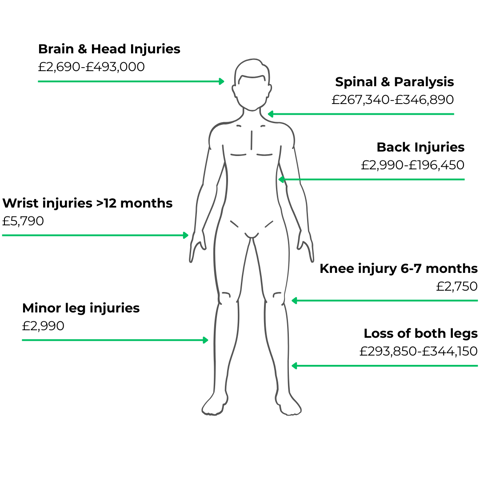
| Injury Category | Typical Description | General Damages Range (£) |
| Minor Injuries | Full recovery less than 7 days | A few hundred to £840 |
| Minor Injuries | Full recovery less than 28 days | £840-£1,680 |
| Minor Injuries | Full recovery less than 3 months | £1,680-£2,990 |
| Back Injuries | Minor (recovery within 3–12 months) | £2,990-£5,310 |
| Back Injuries | Moderate (muscle/ligament, long recovery) | £15,260-£33,880 |
| Back Injuries | Severe (disc/root damage, chronic pain) | £47,320-£196,450 |
| Brain & Head Injuries | Minor head/brain | £2,690-£15,980 |
| Brain & Head Injuries | Less severe ABI | £18,750-£52,550 |
| Brain & Head Injuries | Moderate ABI | £52,550-£267,340 |
| Brain & Head Injuries | Moderately severe ABI | £267,340-£344,150 |
| Brain & Head Injuries | Very severe ABI | £344,150-£493,000 |
| Spinal & Paralysis | Paraplegia | £267,340-£346,890 |
| Spinal & Paralysis | Tetraplegia | £396,140-£493,000 |
| PTSD | Less severe | £5,220-£10,810 |
| PTSD | Moderate | £10,810-£30,580 |
| PTSD | Moderately severe | £30,580-£79,080 |
| PTSD | Severe | £79,080-£133,000 |
| Multiple Injuries | Severe & special damages | Up to £5000,000+ |
Compensation amounts are taken from the Judicial College Guidelines (18th edition). These guidelines are used by courts, solicitors and insurers in England and Wales to assess compensation in personal injury claims.
An accident at work claim is the legal process that lets employees and other workers seek financial compensation for injuries caused by their employer's negligence.
You may be eligible to claim if your employer failed to provide a safe place of work, a safe system of working, or adequate training and equipment. Claims can cover a wide range of incidents, from physical injuries caused by unsafe conditions to accidents involving faulty equipment or lack of proper supervision. These types of accidents often occur where risks have not been properly identified, assessed, or managed in the workplace. Even if you were partly at fault, you may still be able to claim under contributory negligence rules, although your compensation may be reduced to reflect your share of responsibility.

Common types of workplace accidents in the UK include:
We have experience helping people from a wide range of sectors, including construction, factory and warehouse work, courier and delivery driving, railway work, and cases involving defective or dangerous equipment.
Some industries carry a higher risk of serious or fatal workplace accidents, particularly agriculture, forestry and fishing, construction, manufacturing, and transportation and storage.
Whatever your industry, your employer has a legal duty of care to take reasonable steps to keep you safe at work.

When it can be shown that your employer was negligent, you may be able to claim for both general and special damages.
The amount of compensation depends on the severity of your injuries, the impact on your life, and the financial losses you have incurred. Your solicitor will assess your claim to help ensure it reflects the full impact of your injuries.
Workplace accidents rarely happen by chance. In many cases, they are the result of poor planning, improper or lack of training, and failure to follow basic safety procedures. That is why UK law places a clear and non-negotiable duty on all employers to protect the health, safety and welfare of their employees and anyone affected by their work.
Under the Health and Safety at Work etc. Act 1974, all employers must take reasonable steps to reduce risks and prevent accidents from happening in the workplace. This legal responsibility applies to every business, regardless of its size or sector.
At a minimum, your employer should:
If an employer fails to meet these obligations and someone is injured as a result, they could be held legally responsible, even in cases where the accident appears to have been caused by human error.
If you are self-employed and working under the direction of another company, that company may also be held responsible for the conditions that led to your accident.
Fill in the form below to get in touch with one of our dedicated team members, or call our team today on: 0800 260 5010
If you have suffered an accident at work, your immediate priority should always be your health and well-being. Seek medical attention as soon as possible, not only to get a proper treatment for any injuries sustained but to also ensure that those injuries are properly documented from the beginning.
There are also a number of important steps you should take to protect your legal rights:
Report the accident to your employer as soon as possible. Ask for the incident to be formally recorded in the company’s accident book. If one is not available, notify your employer in writing, ideally via email or text message.
Keep a record of all medical treatments, including any hospital visits, prescriptions and referrals.
Photograph the accident scene, as well as your injuries, if possible. These can serve as key evidence later on.
Collect names and contact details of any witnesses who saw the accident or can help confirm the conditions you were working in.
Document all financial losses, such as time off work, any reduced pay, medical expenses, travel costs, or adaptations to your home or car.
Keep a written record of all conversations or correspondence with your employer following the accident.
If you are a trade union member, inform your union representative as soon as possible so they can also support you.
Contact a specialist solicitor to discuss your situation and protect your legal rights
If your injuries are serious and you are off work as a result, your employer is required to report the accident to the Health and Safety Executive (HSE).
Most accident at work compensation claims are funded through a No Win, No Fee agreement. This means you only pay our legal fees if your claim is successful. You may still need to pay any expenses related to your case, such as court fees or expert reports. We will explain any potential costs clearly before you decide to proceed, so there are no unexpected surprises.
In many cases, we can arrange After the Event (ATE) insurance, which can help cover these espenses and protect you from paying the other side's costs if your claim is unsuccessful.
We're helping people just like you all over the UK! Get in touch with our dedicated team today!

A retail worker was loading and unloading delivery cages as she dealt with stock whilst at work. Sadly, it fell onto her causing her to sustain injuries whilst at work.
In England and Wales, you generally have three years from the date of your accident to start a claim. If your injury was not immediately apparent, the three-year period starts from the date of diagnosis or from when you became aware that your condition was linked to the accident.
There are exceptions. If you lack the mental capacity to bring a claim, the time limit does not apply unless capacity is regained, meaning in some cases there may be no time limit.
If the injured person is under 18, a parent or guardian can make a claim on their behalf. Once they turn 18, the standard three-year time limit will apply, meaning they usually have until their 21st birthday to bring a claim themselves.
The sooner you get in touch, the easier it is to gather evidence and build a strong case.
The time it takes to resolve a workplace accident claim depends on the case's complexity, the severity of the injuries, and whether liability is disputed. Straightforward claims can sometimes be settled within a year. More complex cases, particularly those involving court proceedings, may take longer.
Where appropriate, it may be possible to seek interim payments to help cover your medical costs and living expenses while your claim is ongoing. We will keep you updated throughout and work as efficiently as possible to achieve the best outcome for you.
It is not uncommon for employers to suggest that a worker was partly responsible for an accident. This does not prevent you from making a claim. If your employer argues that you share some responsibility, they will need to provide evidence to support this.
Even where contributory negligence is established, you can still receive compensation but your payout may be reduced to reflect your share of responsibility. For example, if you are found to be 20% at fault, your compensation would be reduced by 20%. Our solicitors can advise you on this and work to ensure any reduction is fair and proportionate.
No. Your employer cannot legally dismiss you or treat you unfairly for making an accident at work claim. Most employers have insurance in place specifically to cover these situations.
If your working life becomes difficult because of your employer's response to your claim, and you feel you have no option but to leave, you may have grounds for a constructive dismissal claim. Our team can advise you on your options if this situation arises.
Yes. Health and safety laws apply to all workers, regardless of the type of contract they are on. If you were injured at work because of your employer's negligence, you have the same right to claim compensation as any other employee, whether you are full-time, part-time, temporary, or on a zero-hours contract.
Your employer owes you a duty of care under the Health and Safety at Work etc. Act 1974, and a zero-hours contract does not remove that obligation. If you are unsure about your employment status or whether it affects your claim, our solicitors can review the details of your situation and explain your options clearly.
In most cases, no. All employers are required to hold Employers' Liability Insurance, which is designed to cover workplace accident claims. If your claim is successful, the compensation will typically be paid by your employer's insurance company, not by your employer directly. This is also why making a claim is unlikely to cause your employer serious financial difficulty.
If you have concerns about the impact on your employer, our team can explain what the process involves and answer any questions you might have.
It's important to find a solicitor with not only expertise in workplace accident claims but also a proven track record of delivering results. At Simpson Millar, our depth of expertise and track record are highlighted by our legal rankings and client testimonials.
We put our clients' needs first. We understand that dealing with a personal injury can be challenging, so we focus on providing compassionate support and clear guidance throughout your claim.
Our free, no-obligation assessment of your claim gives you the opportunity to ask questions, understand your options, and decide whether we are the right fit for you.
Call us on 0800 260 5010 or request a callback online to arrange your free, initial claims assessment.






 We're rated‘Excellent’
In this guide, we show the different amounts of personal injury compensation which can be awarded in the UK for different levels of spinal cord injuries, ranging from moderate spinal injury to the most severe spinal injury cases.

If you suffer a manual handling injury at work and believe it’s because your employer didn’t do enough to keep you safe, contact our expert Personal Injury Solicitors.

A concussion may initially appear to be a relatively minor injury. Someone may hit their head in a fall, road traffic collision or workplace accident, attend hospital and return home expecting their symptoms to improve.
Fill in the form below to get in touch with one of our dedicated team members, or call our team today on: 0800 260 5010