








Articles
Legal updates, insights and expert opinion on what matters to you.
If you or a loved one has been the victim of a violent crime, you may be able to claim compensation through the Criminal Injuries Compensation Authority (CICA). Our specialist Criminal Injury Solicitors can guide you through the process and help you access the financial support you may need during your recovery.
Fill in the form below to get in touch with one of our dedicated team members, or call our team today on: 0800 260 5010
From understanding your rights to what happens during a claim, our Personal Injury content hub brings together expert insight, practical guides and real client outcomes.

Criminal injury claims are different from other personal injury claims. They go through a government body with its own rules and application process. This can be difficult to manage, as the claims process can be complex, particularly when you are also trying to recover from a serious injury. Having an experienced Criminal Injuries Compensation Solicitor on your side can help ensure your claim is handled correctly and reflects the full impact of what you have been through.
Simpson Millar has a national reputation for successfully handling criminal injury compensation claims, including cases involving complex circumstances and serious injuries. Our solicitors have been recognised in the Legal 500 and Chambers and Partners for their work.
Everyone on our team understands the devastating effect being injured as a victim of a crime can have. We are committed to getting clients the compensation and rehabilitation they need. You can be confident that we will act firmly whilst maintaining compassion and sensitivity. We will also explain everything in plain English and keep you updated throughout your claim process.
To find out if you have a claim, call us on 0800 260 5010 or request a callback at a time that suits you.

The Criminal Injuries Compensation Authority (CICA) is the government body responsible for compensating victims of violent crime in England, Wales, and Scotland. Applications are made directly to the CICA, usually through an online process. The authority will then assess your claim using evidence such as police reports, medical records, and other supporting information.
You do not need a solicitor to apply to the CICA. However, having specialist legal support can help ensure your claim is properly prepared, that all relevant evidence is included, and that the full impact of your injuries is clearly presented. A solicitor can also assist if you need to request a review or appeal a decision if the value is too low or unfair.
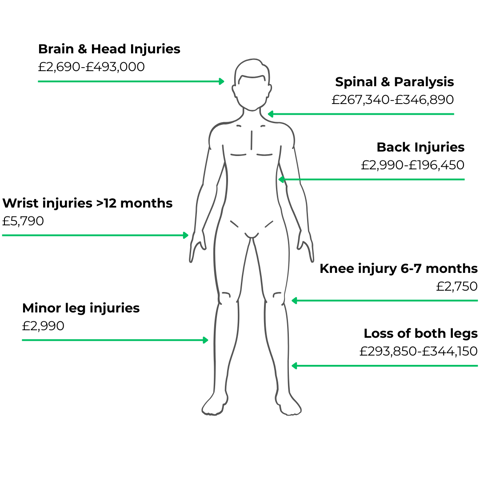
| Injury Category | Typical Description | General Damages Range (£) |
| Minor Injuries | Full recovery less than 7 days | A few hundred to £840 |
| Minor Injuries | Full recovery less than 28 days | £840-£1,680 |
| Minor Injuries | Full recovery less than 3 months | £1,680-£2,990 |
| Facial Scarring | Trivial scarring | £2,260-£4,670 |
| Facial Scarring | Less significant scarring | £5,220-£18,150 |
| Facial Disfigurement | Significant scarring | £12,040-£39,750 |
| Facial Disfigurement | Less severe scarring | £23,730-£63,970 |
| Facial Disfigurement | Very severe scarring | £39,340-£128,590 |
| PTSD | Less severe | £5,220-£10,810 |
| PTSD | Moderate | £10,810-£30,580 |
| PTSD | Moderately severe | £30,580-£79,080 |
| PTSD | Severe | £79,080-£133,000 |
| Brain & Head Injuries | Minor head/brain | £2,690-£15,980 |
| Brain & Head Injuries | Less severe ABI | £18,750-£52,550 |
| Brain & Head Injuries | Moderate ABI | £52,550-£267,340 |
| Brain & Head Injuries | Moderately severe ABI | £267,340-£344,150 |
| Brain & Head Injuries | Very severe ABI | £344,150-£493,000 |
| Spinal & Paralysis | Paraplegia | £267,340-£346,890 |
| Spinal & Paralysis | Tetraplegia | £396,140-£493,000 |
| Multiple Injuries | Severe & special damages | Up to £5000,000+ |
Compensation amounts are taken from the Judicial College Guidelines (18th edition). These guidelines are used by courts, solicitors and insurers in England and Wales to assess compensation in personal injury claims.
Violent crime can affect people in many ways. Compensation through the Criminal Injuries Compensation Authority (CICA) is designed to recognise the impact of physical and psychological injuries. Awards are usually based on a fixed tariff system, depending on the type and severity of your injuries.
A claim may include:
The impact of violent crime can be long-lasting, and it is important that your claim reflects how your injuries have affected you. We can help ensure your application is supported by the appropriate evidence and that the correct tariff and any additional payments are considered.
You may be eligible to claim compensation through the Criminal Injuries Compensation Authority (CICA) if you were injured as a result of a violent crime and meet the scheme’s criteria. These include:
The offender does not need to have been identified, charged, or convicted for you to make a claim.
You can also bring a claim on behalf of someone else, for example, if your child was a victim of a violent crime and is under 18, your loved one lacks the mental capacity to claim, or if you are claiming on behalf of someone who has died as a result of a violent crime.
We handle claims in England and Wales. If the incident took place in Scotland, the process is different, but we can help point you in the direction of a firm that specialises in claims within that jurisdiction.
If you are unsure whether your circumstances meet the CICA's criteria, contact us for a free assessment. We will listen to your situation and explain your options clearly, with no pressure to proceed.
The CICA claims process generally involves the following steps:
We review the details of your case and advise whether you may be eligible to make a CICA claim, along with what options might be available to you.
We prepare and submit your application to the CICA, making sure the full extent of your injuries and losses is clearly set out and supported by available evidence.
The CICA investigates your claim. They may contact the police, witnesses, and medical professionals who have treated you.
The CICA will decide whether you are eligible and, if so, make an award based on the tariff scheme. If we believe you deserve more, we can appeal the decision on your behalf.
If your application or appeal is successful, you will receive compensation.

To assess whether you have a valid CICA application, we will usually ask for:
Navigating the process of a personal injury claim can feel daunting, but understanding the various types of claims can help clarify whether you may be entitled to compensation and what your legal options are.
At Simpson Millar, we handle a wide range of personal injury claims that occur in many different circumstances, including:

In the tragic event of losing a loved one due to someone else’s negligence or wrongdoing, our team helps families seek justice and compensation for their loss.

If you were injured in a road accident caused by another driver we can assist you in securing compensation for your injuries.
If you were injured in a car accident due to another driver’s carelessness or failure to follow the rules of the road, we offer tailored support to help you claim compensation.

If you were injured in a cycling accident caused by the negligence of a driver, road hazard, or other party, we can help you claim the compensation you deserve.
If you sustained injuries in a motorcycle accident caused by another road user’s negligence, we offer expert support and a compassionate approach to securing your compensation.

If you have suffered significant injuries due to someone else’s fault, we are here to ensure that the full impact on your life is recognised and reflected in your claim.

If you’ve sustained a brain injury due to another party’s negligence or unsafe conditions, our experienced team can help you pursue the compensation needed for ongoing care and rehabilitation.

If you have suffered a spinal injury due to the fault of another, we ensure that your claim receives the full attention and support it deserves.

If you were injured on a construction site because of unsafe working conditions or employer negligence, we will help you hold the responsible parties accountable and secure compensation.

If you were injured at work due to unsafe practices, lack of proper safety measures, or negligence, we’ll help you claim compensation from the liable party.
We usually work on a No Win, No Fee basis, which means there are no upfront costs, and you will not pay our legal fees if your claim is unsuccessful.
If your case is successful, a contribution towards our legal fees may be deducted from your compensation. We will explain this clearly from the outset, so you understand how the arrangement works before you decide to proceed.
There may also be additional costs, known as disbursements, such as fees for obtaining medical evidence. In some cases, After the Event (ATE) insurance can be arranged to cover these costs, and your case handler will explain how it works.
Fill in the form below to get in touch with one of our dedicated team members, or call our team today on: 0800 260 5010
We're helping people just like you all over the UK! Get in touch with our dedicated team today!
A criminal injury is any physical or psychological harm caused to you or a loved one by someone committing a violent crime. You do not need to have been the direct target of the crime. In some cases, people who were present during the incident, attempted to intervene, or suffered psychological harm as a result may be eligible to claim. Close family members may also be able to claim where a loved one has been seriously injured or killed, depending on the circumstances.
Common causes of criminal injury claims include:
CICA compensation is based on a tariff system, with awards ranging from £1,000 to £500,000. The tariff sets fixed amounts depending on the type and severities of injury.
Where you have suffered more than one injury, the most serious injury is compensated at 100% of the tariff amount. A second injury may be awarded at 30% of its tariff value, and a third at 15%.
In addition to the tariff award, you may be eligible for further payments in limited circumstances. These can include loss of earnings if you have been unable to work for more than 28 weeks and meet the scheme’s criteria, as well as certain special expenses, such as the cost of necessary equipment or adaptations, where these are not available from other sources.
If the CICA does not award compensation, or if you believe the award does not reflect your injuries, it may be possible to request a review or appeal the decision. We can advise you on your options and, where appropriate, act on your behalf throughout this process.
You usually have two years from the date of the incident to make a CICA claim. It is important to get in touch as soon as you feel ready, as applying sooner makes it easier to gather the evidence needed to support your application.
There are exceptions. If you were under 18 at the time of the incident and the crime was reported to the police before you turned 18, you will usually have until your 20th birthday to apply. If the incident happened before you turned 18 but was not reported to the police until you were an adult, the two-year time limit will generally run from the date the matter was reported.
The CICA can make exceptions in certain circumstances, although these are considered on a case-by-case basis. If you are unsure how the time limits apply to your situation, we can advise you on your options.
The Criminal Injuries Compensation Authority (CICA) handles a high volume of claims each year and prioritises certain cases, including older applications and those involving particularly vulnerable applicants.
It is common for a claim to take up to 12 months or more to be finalised, although more complex cases, particularly where the long-term impact of your injuries is not yet clear, can take longer.
In some cases, an interim payment may be considered where there are urgent financial needs, although this is not available in all claims and depends on the circumstances.
Working with a specialist Criminal Injuries Claims Solicitor can help ensure your application is properly prepared and supported by the necessary evidence, which can assist the process and reduce the risk of delays.
Criminal injuries compensation is paid by the CICA, which is funded by the government. Unlike personal injury claims made against an individual or their insurer, CICA claims are made through a government scheme designed specifically to compensate victims of violent crime.
This means you may still be able to claim compensation even if the offender has not been identified has not been convicted, or does not have the means to pay.
Yes. If the CICA refuses your claim or makes an offer that does not reflect the true extent of your injuries, you have the right to request a review of the decision. A review request must be submitted to the CICA within 56 days of the original decision.
If you are unhappy with the outcome of that review, you may then be able to appeal to the First-tier Tribunal (Criminal Injuries Compensation) within 90 days of the review decision.
Our solicitors have experience challenging CICA decisions and will advise you honestly on whether an appeal is likely to succeed. We have helped clients secure significantly higher amounts on appeal than they were originally offered, including in cases where initial awards were below what the injuries warranted.
Yes. One of the most important things to understand about CICA claims is that the offender does not need to have been identified, arrested, charged, or convicted for you to receive compensation. The CICA scheme is specifically designed to support victims of violent crime regardless of whether the criminal justice process has concluded.
What matters is that you reported the crime to the police as early as possible and cooperated with any investigation. If the police or criminal justice system advised you to delay making a claim, for example, because an active prosecution was ongoing, the CICA may take this into account if your application falls outside the two-year limit.
Having a criminal record does not automatically prevent you from making a CICA claim, although it can affect the outcome. The CICA will consider any unspent convictions into account when assessing your application and may reduce or refuse an award depending on the nature and seriousness of those convictions. Each case is assessed on its own circumstances.
If you are concerned that your criminal record may affect your claim, our solicitors can review your situation and give you a clear, honest assessment of your prospects before you apply. We will not encourage you to pursue a claim unless we believe it has a reasonable chance of success.
Contact us today on 0800 260 5010 for a free, no-obligation and confidential initial assessment, or request a callback at a time that suits you. We will listen to what you have been through and explain options available to you.




 We're rated‘Excellent’
A concussion may initially appear to be a relatively minor injury. Someone may hit their head in a fall, road traffic collision or workplace accident, attend hospital and return home expecting their symptoms to improve.

New research from Simpson Millar reveals the financial pressure facing people after an accident or injury. Almost four in five UK adults said they would return to work sooner than medically advised because of money worries, while six in 10 would consider delaying or skipping treatment. We explore the financial impact of injury, why younger adults feel particularly pressured, and how a personal injury claim may help protect recovery and future financial security.

Contributory negligence does not automatically prevent someone from making a personal injury claim if they were partly responsible for an accident. However, their compensation may be reduced to reflect their share of responsibility. This article explains how contributory negligence can arise, how allegations are investigated and challenged, and how courts determine any reduction in compensation. It also explores examples including seat belts, cycle helmets, PPE, workplace safety, slips and trips, and alcohol or impairment.
Fill in the form below to get in touch with one of our dedicated team members, or call our team today on: 0800 260 5010