







Articles
Legal updates, insights and expert opinion on what matters to you.
If you have been injured in an e-bike accident caused by someone else’s negligence, our specialist Personal Injury experts may be able to help you make a compensation claim. We advise e-bike riders, pedestrians, cyclists and other road users who have suffered injuries in collisions or accidents caused by road defects.
Fill in the form below to get in touch with one of our dedicated team members, or call our team today on: 0800 260 5010
From understanding your rights to what happens during a claim, our Personal Injury content hub brings together expert insight, practical guides and real client outcomes.
E-bikes make cycling more accessible, but an accident may still result in serious injuries. Riders have little protection in a collision, whilst the added weight and speed of an electric bike may increase the force of the impact. Broken bones, head and brain injuries, spinal damage, burns and other injuries may affect your health, independence, ability to work and confidence on the road.
At Simpson Millar, our specialists are recognised in the Legal 500 and Chambers & Partners for their work. Our Road Traffic Accident team includes members of the Motor Accident Solicitors Society and the Association of Personal Injury Lawyers, and our Major Trauma Unit supports people who have suffered serious and life-changing injuries.
We offer a free, no-obligation assessment of your claim and handle most personal injury claims on a No Win, No Fee basis.
To speak to an e-bike accident expert today, call 0800 260 5010 or request a callback.
We handle e-bike accident claims arising from a wide range of circumstances, including:
If you are unsure whether you may be able to make a claim, contact us for a free, confidential assessment. We will explain your options clearly and without obligation to proceed.
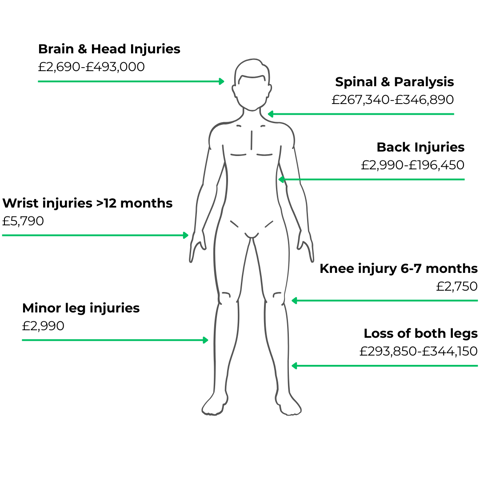
| Injury Category | Typical Description | General Damages Range (£) |
| Minor Injuries | Full recovery less than 7 days | A few hundred to £840 |
| Minor Injuries | Full recovery less than 28 days | £840-£1,680 |
| Minor Injuries | Full recovery less than 3 months | £1,680-£2,990 |
| Back Injuries | Minor (recovery within 3–12 months) | £2,990-£5,310 |
| Back Injuries | Moderate (muscle/ligament, long recovery) | £15,260-£33,880 |
| Back Injuries | Severe (disc/root damage, chronic pain) | £47,320-£196,450 |
| Brain & Head Injuries | Minor head/brain | £2,690-£15,980 |
| Brain & Head Injuries | Less severe ABI | £18,750-£52,550 |
| Brain & Head Injuries | Moderate ABI | £52,550-£267,340 |
| Brain & Head Injuries | Moderately severe ABI | £267,340-£344,150 |
| Brain & Head Injuries | Very severe ABI | £344,150-£493,000 |
| Spinal & Paralysis | Paraplegia | £267,340-£346,890 |
| Spinal & Paralysis | Tetraplegia | £396,140-£493,000 |
| Neck Injuries | Moderate | £33,020-£50,850 |
| Neck Injuries | Moderately severe | £60,080-£73,970 |
| Neck Injuries | Severe | £86,680-£172,970 |
| PTSD | Less severe | £5,220-£10,810 |
| PTSD | Moderate | £10,810-£30,580 |
| PTSD | Moderately severe | £30,580-£79,080 |
| PTSD | Severe | £79,080-£133,000 |
Compensation amounts are taken from the Judicial College Guidelines (18th edition). These guidelines are used by courts, solicitors and insurers in England and Wales to assess compensation in personal injury claims.
E-bike accident claims may involve several areas of law. The correct claims process may depend on how the accident happened, who was involved and whether the e-bike met the legal requirements for an electrically assisted pedal cycle.
Our team understands the evidence often needed to investigate these accidents and build a strong case. Depending on the circumstances, this may include police reports, witness evidence, CCTV, dash cam or action camera footage, photographs, medical records, road inspection documents, product specifications and evidence relating to the e-bike’s motor, battery or speed.
Where responsibility is admitted, or there is strong evidence supporting the claim, it may be possible to secure an interim payment before final settlement. This may help fund rehabilitation, treatment, lost earnings, specialist equipment, care, or home adaptations whilst the claim is ongoing.
We will keep you updated, explain everything in plain English and support you through every stage of the claims process.
We're helping people just like you all over the UK! Get in touch with our dedicated team today!
The legal term for a road-legal e-bike is an electrically assisted pedal cycle, also known as an EAPC.
To qualify as an EAPC, the cycle must have pedals that can be used to move it forwards. Its electric motor must have a maximum continuous rated power output of no more than 250 watts and must stop providing assistance once the cycle reaches 15.5 mph.
A compliant EAPC is treated in much the same way as an ordinary pedal cycle. The rider must be at least 14 years old, but does not need a driving licence, vehicle registration, road tax or compulsory motor insurance.
Some throttle-assisted e-bikes require vehicle approval, even where their maximum assisted speed does not exceed 15.5 mph. The legal status of a particular e-bike may therefore depend on its specifications and approval.
An electric bike that does not meet the EAPC requirements may be legally treated as a motorcycle or moped rather than a pedal cycle. This may apply where the motor has a continuous rated power output above 250 watts, the motor continues to propel the bike above 15.5 mph, or the bike does not have pedals capable of moving it forward.
When used on public roads, a vehicle in this category is subject to requirements that may include registration, tax, insurance, an appropriate driving licence, vehicle approval and an approved motorcycle helmet.
The classification of the e-bike may also affect the legal route available following an accident, so it is important to establish its specifications at an early stage. Using the vehicle on private land with the landowner's permission is a different legal situation, although other legal requirements may still apply depending on the circumstances.
Compulsory motor insurance is not required for an e-bike that meets the EAPC rules. Some riders choose to take out cycle insurance or third-party liability cover. Hired and shared e-bike schemes may also provide insurance under their terms, although the scope of that cover will vary.
An e-bike that falls outside the EAPC rules and is legally classed as a motorcycle or moped must usually be insured before it is used on a public road.
You may be able to make a claim where another person or organisation was wholly or partly responsible for the accident. This may include collisions caused by negligent drivers, accidents caused by dangerous road defects, injuries linked to defective components, or workplace accidents where appropriate safety measures were not in place.
The fact that you were riding an e-bike rather than a standard bicycle does not prevent you from making a claim. The legal status and condition of the e-bike may still be relevant when responsibility is assessed.
You may be able to make a claim if an e-bike rider caused your injuries through negligent or dangerous riding. The legal route available will depend on whether the bike was a compliant EAPC, whether any insurance applies, and the circumstances of the accident.
A compliant EAPC does not require compulsory motor insurance. The rider may still have third-party liability cover through a personal insurance policy, cycling membership, household insurance, or a hire scheme. Where applicable insurance is in place, a claim may be made against that insurer. If no insurance applies, it may be necessary to pursue a claim against the rider personally.
If the e-bike did not meet the EAPC requirements and was legally classed as a motor vehicle, a claim through the Motor Insurers' Bureau (MIB) may be possible where the rider was uninsured or cannot be traced, provided the relevant scheme requirements are met. We will assess the circumstances and explain which legal route may be available to you.
Your immediate priority should be your safety and health. Call 999 if anyone is seriously injured or the road is blocked.
If you are able to do so safely:
Contacting us at an early stage may also help preserve important evidence and establish the correct claims process.
Every claim is different and the compensation is generally divided into two categories.
General damages compensate for your pain, suffering and the impact your injuries have had on your quality of life, daily activities and independence.
Special damages cover financial losses and expenses caused by the accident. These may include:
We work with independent experts where appropriate to assess the full impact of the injuries before valuing the claim.
You may still be able to make a claim if you shared some responsibility for the accident.
This is known as contributory negligence. Any compensation awarded may be reduced to reflect your share of responsibility. For example, if you were found to be 20% responsible, your compensation would usually be reduced by 20%.
Matters such as road positioning, lighting, speed, visibility, helmet use and the legal status of the e-bike may be considered, but none of these automatically determines the outcome. Each case must be assessed using the available evidence.
There is no general legal requirement to wear a cycle helmet when riding a compliant EAPC.
Not wearing one does not automatically prevent a claim. The other side may argue that a helmet would have reduced a particular head injury, but any proposed reduction in compensation would depend on medical and other evidence.
A motorcycle helmet is required where the electric bike is legally treated as a motorcycle or moped.
You usually have three years from the date of the accident to begin a personal injury claim in England and Wales.
Different rules apply to children and people who lack the mental capacity to manage their own claim. A parent, guardian or another suitable adult may bring a claim on behalf of a child. If no claim is made before the child turns 18, they will usually have until their 21st birthday to begin one themselves.
Where the injured person lacks mental capacity, the usual three-year period does not run whilst that lack of capacity continues.
Other procedural deadlines may apply depending on the type of claim, so it is important to seek advice as early as possible.
Most claims are resolved through negotiation without the need for a final court hearing.
Court proceedings may be started where responsibility is disputed, evidence needs to be protected, or the parties cannot agree an appropriate settlement. Even after proceedings begin, many claims settle before trial.
If a hearing becomes necessary, your legal team will explain what to expect and support you throughout the process.
We handle most e-bike accident claims on a No Win, No Fee basis. This means you will not usually need to pay any upfront legal fees.
There may be additional expenses associated with the claim, known as disbursements, such as court fees and expert report fees. After the Event insurance may be available to help cover certain costs and protect you from paying the other side’s legal costs if the claim is unsuccessful.
We will explain the funding arrangement and any potential costs clearly before you decide whether to go ahead with the legal process.
Call us on 0800 260 5010 or request a callback online. One of our experts will discuss what happened, explain whether you may be able to make a claim and answer your initial questions.
The first assessment is free, confidential and carries no obligation to proceed.






 We're rated‘Excellent’
Lorem ipsum dolor sit amet, consectetur adipiscing elit, sed do eiusmod tempor incididunt ut labore et dolore magna aliqua.

Lorem ipsum dolor sit amet, consectetur adipiscing elit, sed do eiusmod tempor incididunt ut labore et dolore magna aliqua.
Lorem ipsum dolor sit amet, consectetur adipiscing elit, sed do eiusmod tempor incididunt ut labore et dolore magna aliqua.
Lorem ipsum dolor sit amet, consectetur adipiscing elit, sed do eiusmod tempor incididunt ut labore et dolore magna aliqua.
Fill in the form below to get in touch with one of our dedicated team members, or call our team today on: 0800 260 5010