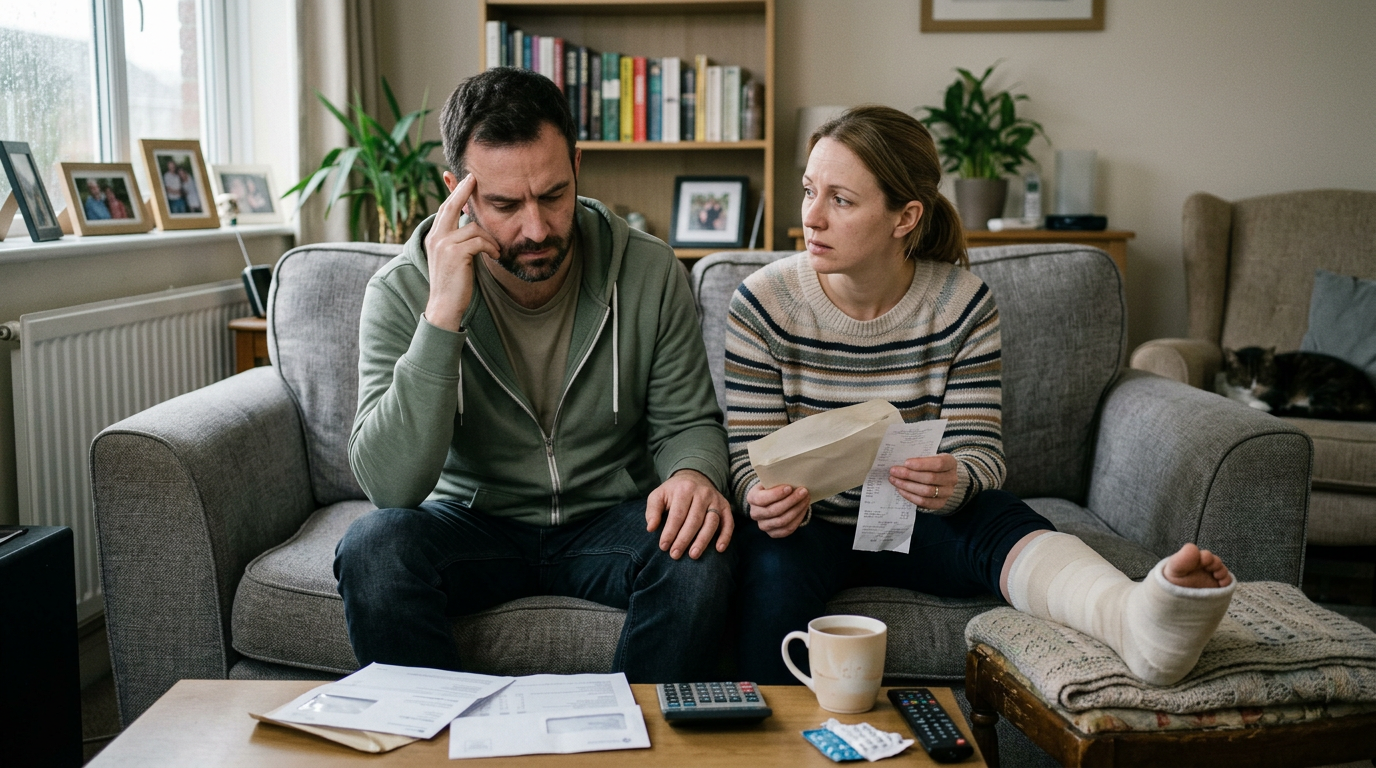
Money worries are pushing Brits back to work before they have recovered from an accident or injury

Posted on: 10 mins read
Susan Vanden

Team Leader & Partner, Road Traffic Accidents

Share Article:

An accident can happen in seconds, but the consequences can affect someone's health, work and finances for months or even years. 

For many people, one of the first concerns after an accident or injury is likely to be getting better. But what happens when taking the time needed to recover has a financial impact? 

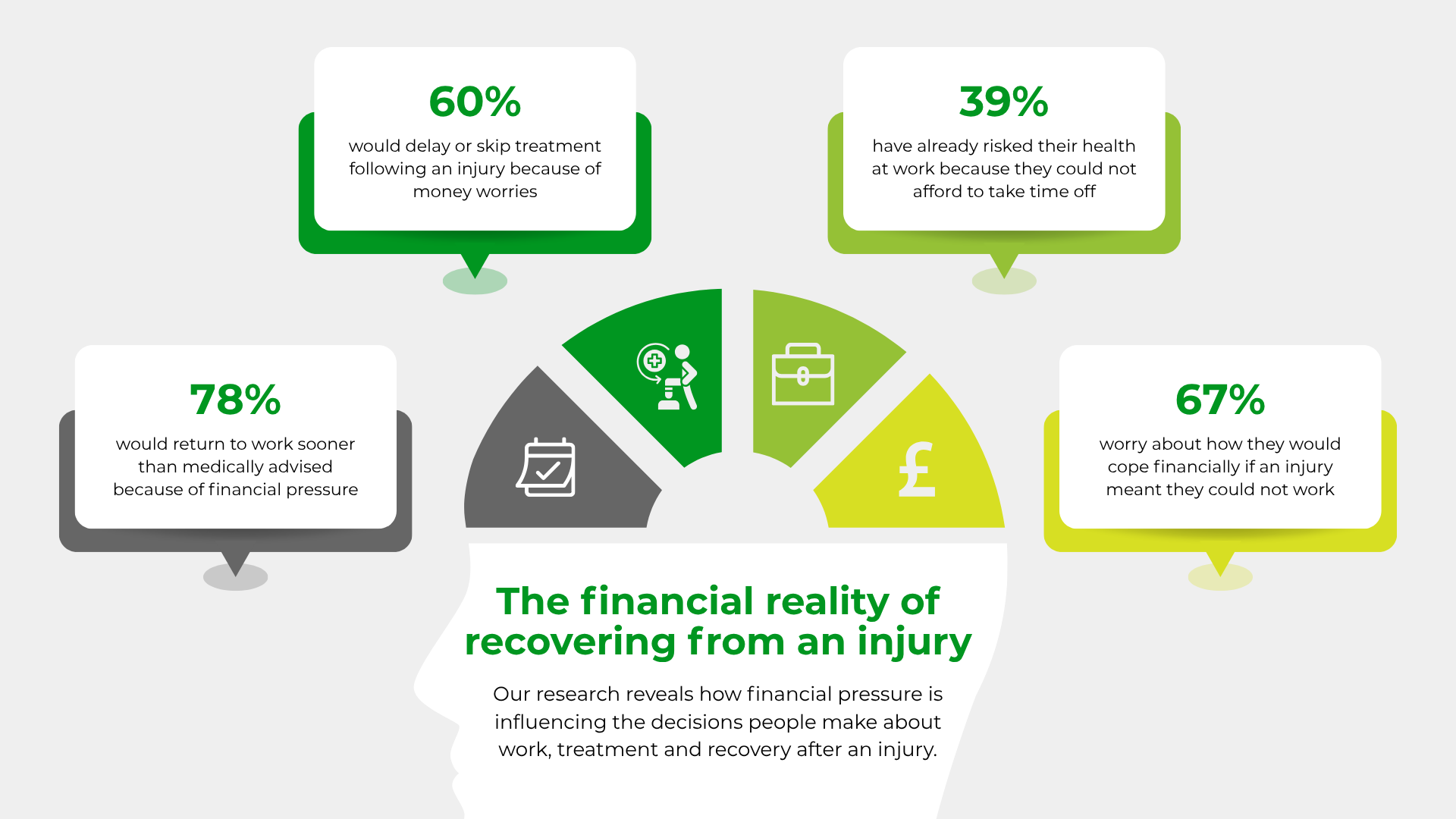
We recently conducted independent research among 2,000 UK adults which revealed the scale of that conflict. Almost four in five people (78%) said they would be likely to return to work sooner than medically advised following an accident or injury because of the financial pressure of being unable to work. 

The findings suggest that, for a significant proportion of people, recovery is not simply a question of how long their body needs to heal. The amount of time they feel they can afford to take away from work could play a major part too. 

And returning to work early is only part of the picture. Our research looked more widely at the choices people could face if an injury affected their income, from putting off treatment to worrying about how they would continue to afford everyday living costs. 

It reveals a difficult reality: when an accident interrupts someone's ability to earn, protecting their finances and protecting their health can quickly begin to feel like competing priorities. 
 

TrustpilotStarsWe're ratedExcellent

Financial pressure could cut recovery short 

Being told to take time away from work is one thing. Being financially able to do it is another. 

Among the people we surveyed, 30% said they would be ‘very likely’ to return to work before medically advised because of the financial impact of being off. 

The reasons someone might feel that pressure will differ. Some employees receive contractual sick pay from their employer, which may cover some or all of their usual salary for a period of absence. Others may have to rely on Statutory Sick Pay (SSP), whilst people's savings, household income and other financial support will also vary considerably. 

Changes introduced on the 6 April 2026 made SSP available from the first full day of sickness absence and removed the previous minimum earnings requirement. For eligible employees, it is currently paid at 80% of average weekly earnings or £123.25 a week, whichever is lower. 

Although the changes mean more employees can access SSP from the beginning of an absence, there can still be a considerable difference between someone's normal wage and sick pay.   

That difference matters when the same bills continue arriving. 

Housing costs, food, energy, transport, childcare, debt repayments and other regular expenses do not stop because someone has been injured. An accident can therefore create a sudden gap between what a household normally earns and what it has available to spend. 

That concern was reflected strongly in our research. Two thirds of UK adults (67%) said they were worried about how they would cope financially if an injury meant they could not work. Women reported particularly high levels of concern, at 74%, compared with 61% of men. 

Our research also suggests that many people have little financial cushioning to fall back on. When we asked respondents how much they currently had in personal savings, more than a quarter (26%) said they had no personal savings at all. 

Wider UK research reflects a similar picture. The Financial Conduct Authority's Financial Lives research found that one in 10 UK adults had no cash savings at all, with a further 21% having less than £1,000 available to draw on in an emergency. 

Taken together, the findings show why even a relatively short period without someone's usual earnings could be difficult to absorb. 


Six in 10 would put treatment at risk because of money 

The pressure to earn could also influence what happens away from the workplace. 

Our research found that 60% of UK adults would be likely to delay or skip treatment, such as physiotherapy or rest, following an injury because of financial pressure to return to work. 

It is an important finding because recovering from an injury does not always end when someone leaves hospital, sees their GP or feels well enough to start doing more. 

Depending on the injury, recovery can involve follow-up appointments, physiotherapy, rehabilitation, medication, further procedures, periods of rest or gradually rebuilding someone's strength and independence. 

For someone with a more serious injury, rehabilitation may involve a team of different professionals and continue over a much longer period. 

Missing or delaying treatment is not necessarily a decision someone wants to make. Our findings suggest that financial circumstances could become part of that decision for many people. 

There may be practical pressures too. Attending appointments can mean taking additional time away from work, arranging transport or childcare, or travelling to receive treatment. Someone who has already lost income because of an injury may therefore find themselves weighing up another immediate financial cost against something intended to support their longer-term recovery. 


For many, an injury has already come with a financial cost 

Our research also looked beyond what people might do, hypothetically, following an injury and explored the financial impact experienced by those who have already been affected. 

Almost a quarter of respondents (24%) said they had previously lost income because of an injury or accident. 

For people whose most recent injury affected their ability to work, the period away from work could be significant. The average time off was 8.3 weeks, with 29% away for one to two weeks, 21% for three to four weeks and 18% for two to three months. 

Not everyone received financial support during that time. Among those whose most recent injury had affected their ability to work, one in four (25%) said they received no financial support, while 44% received Statutory Sick Pay. 

The effects could also continue beyond the initial absence from work. When respondents who had experienced an injury were asked how it had affected them financially, 42% said they were worse off following their most recent injury, including 13% who said they were ‘significantly’ worse off. 

These findings show why the financial consequences of an injury cannot always be measured simply by the number of days someone spends away from work. A period of reduced or lost income can leave a financial impact that continues even after someone has returned to work. 


Younger adults are feeling the greatest pressure 

The pressure was not felt equally across all age groups. It was most pronounced among younger adults. 

Almost nine in 10 people aged 18 to 24 (88%) said they would be likely to return to work sooner than medically advised because of money worries. Among those aged 55 and over, the figure was 65%. 

An even wider gap appeared when we asked about treatment. Almost three quarters (74%) of 18 to 24 year olds said financial pressure could lead them to skip or delay treatment, compared with half (50%) of people aged 55 and over. 

Our survey does not establish why different age groups responded in this way, and people's individual circumstances will vary considerably. For example, someone at the beginning of their working life may have different savings, housing costs, employment arrangements and financial commitments from someone approaching retirement. What the research demonstrates is that age appears to influence how able people feel to prioritise recovery when their income is at risk. 


Making a personal injury claim 

When an accident was caused by someone else's negligence, it may be possible to make a personal injury claim to get compensation, which can help to relieve financial pressure in the short and longer term.  

Being injured can affect someone's income, but the consequences may extend into many other parts of their life too. They may need treatment or rehabilitation, rely on other people for help, be unable to return to the same job or find that activities they previously enjoyed are no longer possible. 

Compensation is intended to reflect the impact the injury has had, and may continue to have, on the individual. When valuing a personal injury claim, compensation is broadly divided into two main types: general damages and special damages. 

General damages compensate for the pain and suffering caused by the injury and the effect it has had on someone's quality and enjoyment of life. For example, an injury could affect their ability to exercise, take part in hobbies, socialise, travel, look after their family or carry out everyday activities independently. 

Special damages cover the financial losses and additional costs caused by the injury. Depending on someone's circumstances, these may include:

  • earnings already lost because they have been unable to work
  • future loss of earnings if their ability to work or progress in their career has been affected
  • loss of pension or pension contributions where the injury has affected their ability to work
  • treatment and rehabilitation costs
  • care and assistance, including support provided by family or friends
  • travel and other expenses resulting from the injury
  • specialist equipment or adaptations to someone's home or vehicle
  • additional support that may be required in the future 

In serious injury claims, it may also be possible to seek interim payments before the claim has concluded, where the legal requirements are met. These are advance payments of compensation that can help with immediate needs, such as rehabilitation, care, equipment or financial pressures caused by being unable to work, rather than requiring someone to wait until their final compensation has been agreed. 

We also recognise that the cost of seeking legal advice can be another concern at a time when someone's finances may already have been affected by an injury. We take on most Personal Injury claims on a No Win, No Fee basis, subject to the circumstances of the case. 

This generally means there are no upfront legal fees to start the claim, helping people access legal support without having to fund the cost of pursuing a claim themselves from the outset. We will explain how the funding arrangement works, including any fees that may apply if the claim is successful, before someone decides whether to proceed. 

For someone already worried about losing income, paying for treatment or meeting everyday costs, getting legal advice should not create another immediate financial barrier.


The real cost of an injury can be what happens next 

Susan Vanden, Partner in our Personal Injury team, said: 

“For me, these findings expose something we do not talk about enough. There can be a significant gap between the recovery someone is medically advised to have and the recovery they can realistically afford. 

“That matters because decisions made in the weeks and months after an accident can have consequences much further into the future. If somebody feels they have no option but to prioritise their finances, they may be making decisions at one of the most vulnerable points in their life without yet knowing the full extent of their injury or what it could mean for them longer term. 

“It is also why we need to move away from the idea that a personal injury claim is simply about receiving compensation once everything is over. Done properly, the legal process should be looking forward as well as back. It should ask what needs to happen now to give that person the best possible opportunity to recover, regain independence and protect their future. 

“There is an important difference between compensating somebody for money they have already lost and recognising that an injury may change the course of their working life altogether. Someone may have expected decades of earnings, career progression and financial independence ahead of them. A serious injury can alter those expectations overnight, and a claim needs to consider that longer-term reality. 

“I also think there is a wider access to justice point here. If financial pressure is already influencing the decisions people make after an injury, concern about the cost of seeking legal help should not become another barrier. That is why funding options such as No Win, No Fee are important. 

“Ultimately, the purpose of a claim should be to put someone in the strongest position possible for the life that comes after the accident. We cannot undo what has happened, but we can look at what has been taken away, what can be restored and what support is needed to give that person greater security for the future. 

“If an accident caused by somebody else's negligence has left you worried about what happens next, speak to our experts. Understanding your legal options early can be an important first step in protecting both your recovery and your future.” 


Our research was conducted by Censuswide among a nationally representative sample of 2,000 UK consumers between 19.06.2026-22.06.2026. Censuswide is a member of the Market Research Society and the British Polling Council, and a signatory of the Global Data Quality Pledge. 

Our clients rate us asExcellentStars4.5 out of 5 based off 3146 reviewsTrustpilot

Susan Vanden

Team Leader & Partner, Road Traffic Accidents

Areas of Expertise:
Road Traffic Accidents

Susan specialises in managing road traffic accident cases, and mainly represents pedestrians, cyclists, motorcyclists in multi-track cases, as well as clients who have developed chronic pain syndrome and sustained organic injuries.

She also supports junior members of staff across the department.

References:

Simpson Millar Solicitors. (n.d.). Simpson Millar | The Open Lawyers | Call 0800 260 5010 Today. [online] Available at: https://www.simpsonmillar.co.uk/ 

GOV.UK (2023). Statutory Sick Pay (SSP). [online] GOV.UK. Available at: https://www.gov.uk/statutory-sick-pay 

FCA. (2025). More people have bank accounts but one in ten have no cash savings, FCA survey reveals. [online] Available at: https://www.fca.org.uk/news/press-releases/more-people-have-bank-accounts-one-ten-have-no-cash-savings 

GOV.UK. (2026). Family Resources Survey: financial year 2025 to 2026. [online] Available at: https://www.gov.uk/government/statistics/announcements/family-resources-survey-financial-year-2025-to-2026 

Rankin, C. (2024). Understanding Interim Payments | Simpson Millar Solicitors. [online] Simpsonmillar.co.uk. Available at: https://www.simpsonmillar.co.uk/personal-injury-solicitors/guides/understanding-interim-payments/ 

Simpsonmillar.co.uk. (2016). Susan Vanden. [online] Available at: https://www.simpsonmillar.co.uk/our-people/susan-vanden/ 

Simpsonmillar.co.uk. (2021). No Win No Fee Personal Injury Claims & Solicitors. [online] Available at: https://www.simpsonmillar.co.uk/personal-injury-solicitors/no-win-no-fee-personal-injury-solicitors/ 

Simpsonmillar.co.uk. (2024). Pothole Accident Claims. [online] Available at: https://www.simpsonmillar.co.uk/personal-injury-solicitors/serious-injury-claims/ 

www.simpsonmillar.co.uk. (2023). Personal Injury Solicitors & No Win No Fee Injury Solicitors | Simpson Millar Solicitors. [online] Available at: https://www.simpsonmillar.co.uk/personal-injury-solicitors/  

Get in touch, today!

Fill in the form below to get in touch with one of our dedicated team members, or call our team today on: 0800 260 5010

This data will only be used by Simpson Millar in accordance with our Privacy Policy for processing your query and for no other purpose