


-
Post-Concussive Syndrome Disrupts Brain Connectivity - US Study
-
Dated:
28/07/2011
Key Contact:
Neil Fearn
Sufferers of mild traumatic brain injury (MTBI) show abnormal functional connectivity in the part of the brain which distributes information, a new US study has found.
Reporting in the online journal 'Radiology', New York University's Dr Yulin Ge discovered that the functional connectivity of thalamocortical networks increases when an MTBI subtly injures the thalamus, a central relay station for transmitting information throughout the brain.

"These findings, which were determined using resting-state functional MRI, promise better explanations for the underlying causes of a variety of post-traumatic symptoms that are difficult to spot with conventional imaging methods," Dr Ge said.
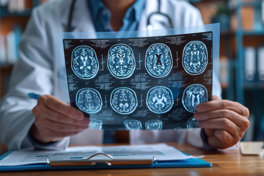
Since patients with MTBI typically show no visible structural brain abnormalities, researchers have begun using special imaging detection techniques. Of these, resting-state functional MRI (RS-fMRI) is rapidly proving a powerful way to assess connectivity between functionally-linked brain regions.
Considered better than conventional diagnostic tools by many medical scientists, RS-fMRI gives insight into functional activity and communication between brain regions, which play key roles in cognitive performance.
Using RS-fMRI, Dr Ge's team studied brain activity in 24 patients with MTBI and in 17 who were healthy. Whilst the healthy group showed a normal pattern of thalamic RSNs with relatively symmetric and restrictive connectivity, this pattern was disrupted in the patients with MTBI, with significantly increased thalamic RSNs and decreased symmetry. These findings corresponded with clinical symptoms and lowered neurocognitive functions in the patients with MTBI.
Comparing the activity of different groups of brain cells helps identify which brain networks are communicating with each other. Some baseline brain activities and resting state networks (RSNs), which include the parts of the brain associated with working memory, can be detected when the brain is at rest.
"The RSNs have great potential for studying thalamic dysfunction in several clinical disorders including traumatic brain injury," said Dr Ge, noting the multi-functional nature of thalamic functional networks, including sensory information process and relay, consciousness, cognition, and sleep and wakefulness regulation.
"The disruption of thalamic RSNs may result in a burning or aching feeling, plus mood swings and sleep disorders, and can contribute to certain psychotic, affective, obsessive-compulsive, anxiety and impulse control disorders," he said. "These symptoms are commonly seen in MTBI patients with post-concussive syndrome."
According to the Centres for Disease Control and Prevention, some 1.5 million Americans a year sustain traumatic brain injuries, with concussion accounting for at least 75%. Following such an injury, some patients briefly lose consciousness, whilst other symptoms - some of which can last for years - include dizziness, headache, memory loss, attention deficit, depression and anxiety.
"The study's findings go a long way to providing a better understanding of the brain and its functions, and they'll be especially beneficial if you've suffered a mild traumatic brain injury such as concussion," commented Neil Fearn in the Brain Injury Team of Simpson Millar LLP. "Effective treatment hasn't been available for MTBJs due to a historically poor understanding of post-concussive syndrome and its causes. Now there's a real opportunity to move forward. The development of RS-fMRI in a medical-legal context is particularly useful in objectively determining MTBI in low velocity road traffic accidents."
Get the news direct to your Email Inbox
If you liked this article you can sign up to receive our news articles via email
here:
Subscribe to our Daily News updates
PR Contact
For any PR enquiries please contact:
Christina Savage at RTS Media
on tel: 01942 396701, mobile: 07932 944 008 or send an email.
Disclaimer: No information on this website shall be construed as
legal advice and information is offered for general information purposes only based
on the current law when the information was first displayed on this website. You
should always seek advice from an appropriately qualified solicitor on any specific
legal enquiry. Calls to or from our legal helpline may be recorded for training
and monitoring purposes.
External links are provided for your convenience, but they are beyond the control
of Simpson Millar LLP and no representation is made as to their content. Use or
reliance on any external links and the content thereon provided is at your own risk.
Full terms of use...